
Hiring a Next.js agency in Romania: what to look for
A practical guide to evaluating a Next.js agency in Romania: a testable live portfolio, transparent pricing, direct developer communication, technical SEO on their own site. Five signals that separate a good agency from one that just sounds good.
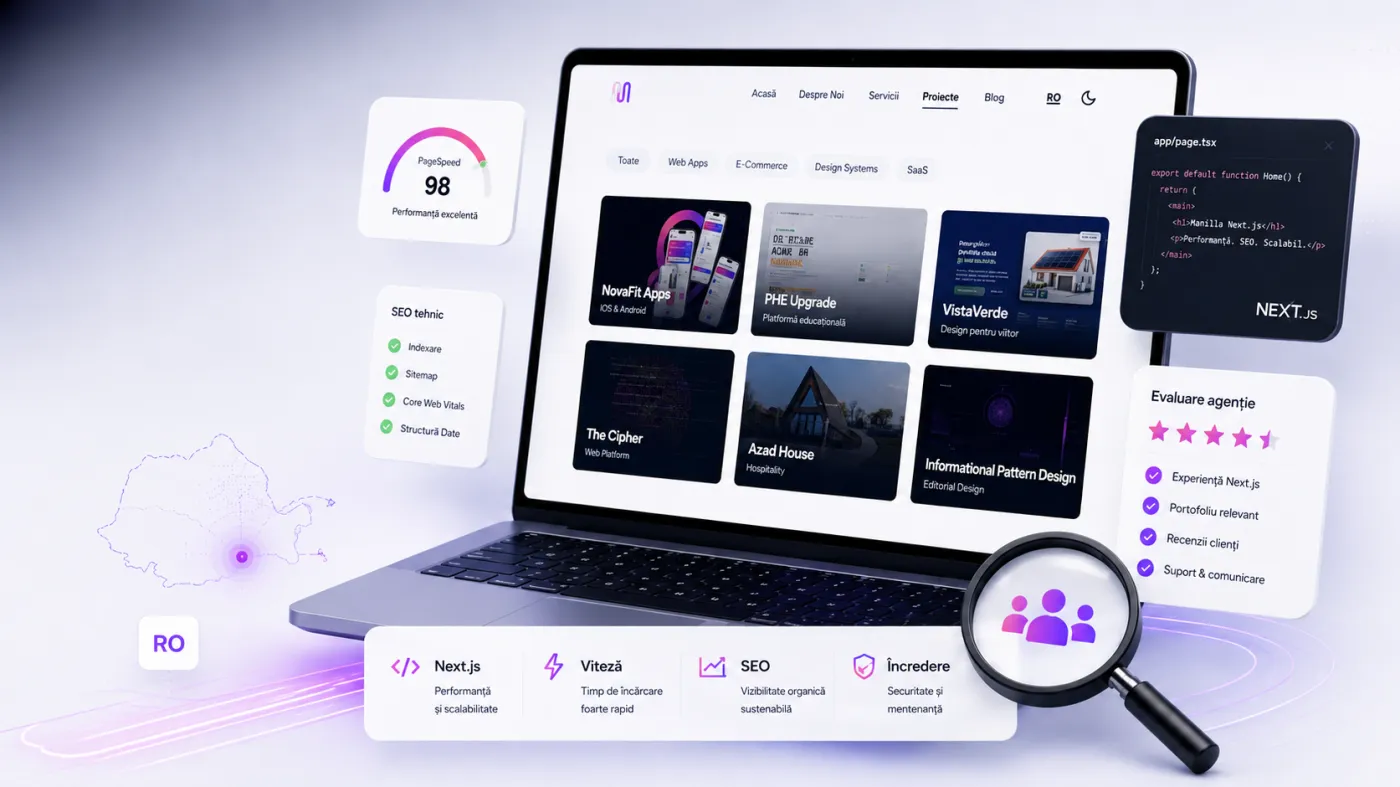
In short: a good Next.js agency has a live portfolio you can test yourself in PageSpeed, a price they'll tell you without dragging you through three calls, and lets you talk directly to the developer. If those three are missing, the rest matters less.
The Romanian market is full of agencies that say "we do Next.js". Some genuinely do, others slap the label on because it's trendy. Here's how to tell them apart, on verifiable signals, not promises.
1. Test the portfolio, don't just look at it
Any agency will show you pretty screenshots. The difference is that a good Next.js site survives a test. Take 2-3 projects from their portfolio, open them and run them yourself in PageSpeed Insights on mobile. A properly built Next.js site has green Core Web Vitals — LCP under 2.5s, CLS near zero. If the "Next.js projects" in the portfolio score poorly on mobile, either it isn't Next.js, or it's poorly built.
Also check they're real, live sites on their own domains — not mockups or demos on subdomains that lead nowhere.
2. Ask for a price and see if they give it
An underrated signal: does the agency publish, or quickly tell you, a price range? Or do they keep you in "request a quote" through long forms only to learn at the end that their first rate card is three times your budget?
Transparent pricing doesn't mean cheap pricing — it means respect for your time and confidence in their own value. An agency that hides the price until the last moment usually negotiates on perception, not on clear deliverables.
3. Confirm who you'll talk to — developer or middleman
Ask directly: "during the project, do I talk to the person writing the code, or to a project manager who relays it further?" For a mid-sized project, direct developer communication shaves weeks off the feedback loop and removes the broken-telephone effect.
Large agencies with 50+ people have management layers — useful for dozens of simultaneous projects, but for a client with 1-3 projects a year it means slower decisions and repeated translations of requirements. It's not wrong, but you should know what you're buying.
4. Look at the SEO on their own site
A quick and revealing test: an agency that claims to do technical SEO should have it on its own site. Open the source of their page and look for structured data (JSON-LD), check whether they have correct hreflang if they're bilingual, a canonical, an llms.txt for AI search. If they preach SEO but their own site lacks it, that's a signal.
This matters even more now that search is moving toward AI — AI Overviews, ChatGPT search, Perplexity. Clean structured data and speed are exactly what you need to be cited there. That's the kind of work we do in the SEO/AI audit with code-level fixes.
5. Ask about the stack and post-launch maintenance
Next.js is a good choice, but not for everything. An honest agency tells you when Next.js is NOT the answer (e.g. a blog edited daily by a non-technical team is often better on WordPress). If every problem gets "Next.js" as the answer, that's framework selling, not consulting.
Also ask what happens after launch: who maintains the site, how updates are done, what maintenance costs. A site that's shipped and abandoned degrades. For custom flows and web apps where the stack matters, look at their experience with custom web apps.
Red flags
- "We guarantee #1 on Google" — no serious agency guarantees that
- A portfolio with no live links you can test
- Price hidden until after several calls
- You can't talk to the developer, only to sales
- Their own site is slow or has no structured data
- The answer is always "Next.js", regardless of the question
How we work
We're a small agency from Constanța, remote across Romania. Our portfolio is live and testable, prices are published on the site, you talk directly to the developer, and if WordPress is the right answer for you, we'll tell you that — we won't force Next.js on you. If you first want to understand why Next.js for business, see the complete guide.
If you're evaluating agencies for a Next.js project, drop us a line with a few details. We'll give you an honest reaction and, if we're not a fit, we'll tell you that too.