
From a folder of 40 PDFs to a bilingual site, live — in two days
One client, one folder of PDF spec sheets and PowerPoint decks. Two days later: a bilingual site live, with full SEO, prices checked against the spec sheets and a working form. The process, step by step — including the parts nobody usually tells you about.
This is what the starting point of most presentation websites looks like, even if nobody puts it in a portfolio: a folder. In VistaVerde’s case — a photovoltaic systems integrator from Câmpina — the folder held 40-some files: PDF spec sheets from five suppliers, internal PowerPoint decks, photos sent over WhatsApp from the job site and a logo in JPEG. Zero site copy. Zero structure. Zero design.
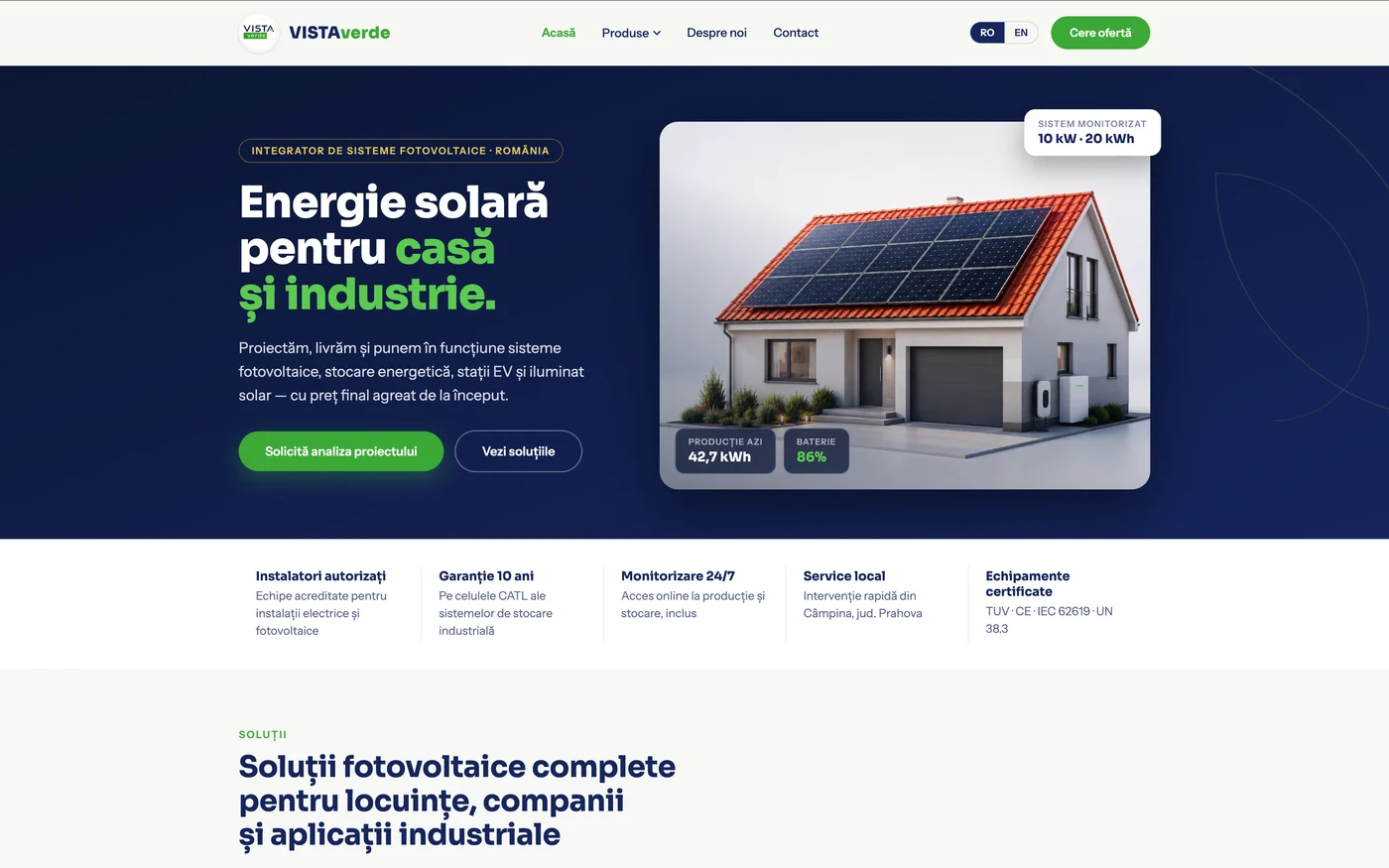
Two working days later, vistaverde.ro was live: 13 pages in two languages, prices checked against the spec sheets, an SEO score of 95/100, a working contact form and the company email moved without a single second of downtime.
This article shows exactly how it happened — including the parts nobody usually tells you about: the discrepancies in the supplier documents, the trap that nearly killed the company email at launch, and why the client rewrote the math on one of the charts. And at the end, for the curious, the technical part: how we actually work with AI agents to compress weeks into days.
The truth is in the documents, not in inspiration
Day one didn’t start with design, it started with reading: spec sheets for batteries, panels and inverters, price lists, user manuals. For a site that displays numbers — prices, warranties, specifications — the source of truth isn’t “what sounds good”, it’s the supplier’s document.
This phase surfaced exactly the kind of problems that, left undetected, end up on the site and erode trust:
- The same spec, two values. The battery switchover time during a power cut appeared as “8 ms” in one supplier document and “20 ms” in another. We read both sources: 8 ms was the static switch time (one component), 20 ms was the guaranteed full switchover. The guaranteed figure went on the site — and in the spec table, the exact technical value, with context.
- A wrong panel efficiency. One model showed 23.2% in one place and 23.5% in another. The spec sheet settled it: 23.5%.
- Prices, checked to the decimal. Every price on the site was cross-checked against the client’s price table. They all matched, at a rate of 5.00 lei/euro — but “they all matched” is a conclusion you can only state if you actually did the check.
The moral for any project: the site is an interface over the company’s reality. If the reality in the documents is contradictory, the contradiction has to be resolved before anyone writes a line of HTML.
Design is decided on screen, not in Word
We didn’t send the client a document with a “proposed structure”. We built the interactive design of all 11 pages directly — navigable, with real copy pulled from the documents, with the real prices — and iterated it on screen until it looked right.
The difference from the classic process (wireframe → mockup → approval → implementation, with a round of feedback at each step) is brutal: the client reacts to something that looks like the final product, not to abstractions. “Move the chart lower”, “put backup first”, “this photo, not that one” — concrete feedback, applied the same day.
The build: bilingual and SEO from day one, not “optional, at the end”
Once the design was approved, the site was built on Next.js with two decisions taken on day one, not deferred “to phase two”:
Bilingual from the foundation. Romanian on vistaverde.ro/, English on /en/, with correct hreflang tags between them — because VistaVerde also has foreign corporate clients. Retrofitting a second language onto an existing site usually costs more than building bilingual from scratch.
SEO as part of the build. Every page shipped from the factory with: a unique title and description, structured data (Organization, FAQ, Product with prices, breadcrumbs), an Open Graph image generated individually for sharing on WhatsApp/Facebook/LinkedIn, a sitemap with hreflang and a robots.txt. The internal SEO audit run before launch pushed the score from 78 to 95 out of 100 — with the issue list resolved point by point, not just “noted”.
A detail that’s often forgotten: the English version also went through a separate localization audit, with ~90 corrections — from number formats (“63.000 €” means sixty-three thousand to a Romanian and sixty-three euros to an English speaker) to industry terms. A “translated” site that displays prices in the wrong format isn’t bilingual — it’s a translation in form only.
The details that sell: the client’s expertise, baked into the interface
My favourite moment on this project wasn’t technical. The battery page had a financial chart about the savings a storage battery brings. The client looked at it and said, in essence: “The math is wrong. For a household, the solar surplus isn’t free — it’s credited by quantity by the supplier. The real cost of charging the battery is the credit you give up, and the gain is the full price you avoid in the evening. And one more thing: this arbitrage doesn’t sell the battery. The battery sells on backup. The money is the bonus.”
He was perfectly right — it’s his field. The same day, the page was restructured: the backup argument (“you stop caring when the power goes out”) moved up first, and the chart was rebuilt with the correct economics: red bars at midday (the lost credit), green bars in the evening (the full price avoided), with the numbers calibrated to add up to exactly the totals shown — because an attentive client actually does the sum.
No template can do that. A good custom site is the client’s expertise, translated into an interface.
The seamless launch — and the trap that nearly cut the company email
Launch meant: the domain moved to the hosting platform’s nameservers, an SSL certificate, the automatic removal of the anti-indexing protection from the staging version, Google Search Console with the sitemap.
And a classic trap, caught in time: when you move nameservers, the email DNS records (MX) don’t move by themselves. Without intervention, office@vistaverde.ro would have died on launch day itself — including quote requests from clients. We checked the DNS right after the switch, flagged the problem within minutes and rebuilt the mail records (MX, SPF, DKIM) before anyone lost a single message.
Also at launch: the contact form was wired to a real sending service — requests arrive as formatted email straight into the company inbox, with the client’s address on Reply-To, protected against spam on three layers (honeypot, minimum fill-in time, per-IP request limit). And if the sending service ever went down, the form automatically opens the visitor’s email app — not a single request lost.
The final numbers
- Google PageSpeed on the live site: 100 Performance on desktop, 99 on mobile — and 100 on SEO and Best Practices on both. First visible content in 0.3 seconds on desktop, 1.0 on mobile.
- 13 pages × 2 languages (26 indexable routes), plus a guides section for SEO content
- ~2 days from the folder of PDFs to the site live on the domain
- SEO audit score of 95/100 at launch; every image optimized (WebP/AVIF, lazy loading)
- 22 Open Graph images generated individually, one per page per language
- Zero downtime on email during the DNS migration
- 3 test emails sent and confirmed in the inbox before declaring the form working
The performance numbers aren’t a one-off accident we’re proud of once — they’re the consequence of the architecture: statically rendered pages, images served at the exact format and size of the screen, zero useless JavaScript, locally hosted fonts. On that foundation, 90+ isn’t a target, it’s the starting point. That’s why we can guarantee it contractually.
How the work was done, technically (for the curious)
The part that makes the speed difference: a large share of the execution was done by AI agents working in parallel, orchestrated and verified by a human.
- Converting the design into code: the 11 pages were converted simultaneously by 11 agents, each with the same strict fidelity rules (copy reproduced identically, not “improved”; real responsive behaviour instead of design previews). The whole process: under an hour.
- The audits, also with agents — but different ones from those who wrote the code. The English localization audit was done by 6 agents that only report problems, then another 6 applied the corrections. Separating “who does” from “who checks” catches mistakes the author no longer sees.
- Visual verification at every step: after each change, automatic screenshots on desktop and mobile, compared to the previous state. Code that compiles isn’t the same as a page that looks right.
- Git discipline like on any serious project: every change committed atomically, with descriptive messages; nothing goes live without a clean build and a check.
And just as important, what stayed 100% human: the business decisions (which arguments sell, in what order), the domain feedback (the crediting math came from the client, not from the AI), the image selection, the final visual validation and every “publish”. AI compressed the execution; the direction was human the whole time.
Want to see the full result? See the VistaVerde project — with all the pages and performance numbers.
Frequently asked questions
How long does a custom presentation website take? The VistaVerde case: about two days of actual work from raw materials to the live site — because the materials were handed over completely from the start, and feedback came fast. Realistically, including the design iterations and the content that accumulates along the way: one to two calendar weeks.
What do I need to prepare, as the client? The documents. Spec sheets, price lists, project photos, certifications — in any format, however messy. Extracting, structuring and writing the copy is our job. What we can’t invent is your company’s reality.
How is a custom site better than a template? A template gives you a look. A custom site encodes your sales arguments: at VistaVerde, the battery page sells on backup before savings because that’s how his market works — a nuance no template knows. Plus: SEO built into the foundation, not ticked off from a plugin.
What performance scores do you guarantee? We hand over the site with a Google PageSpeed score of 90+ across all four categories — Performance, Accessibility, Best Practices and SEO — measured at handover, on the live site. At VistaVerde we handed over with 100 Performance on desktop and 99 on mobile. The guarantee is at handover for an honest reason: scripts added later (chats, marketing pixels) can lower the score regardless of the foundation — and the foundation is our part.
Is it safe to work with AI on a company website? With the right process, yes — and much faster. The rules that matter: the source of truth is the client’s documents, not the AI’s memory; the agents that verify are different from those that execute; and nothing is published without human validation. AI without these rules produces speed without trust; with them, it produces both.
Got a folder full of PDFs and no site? Get a quote — we’ll tell you within 24 hours what can be built from it, then we get your bilingual site rolling, with SEO and a working form from day one. See our services too.