
How a Codex is born: the story of a library that writes itself
thecipher.is is a living Codex: 462 faceless, collective patterns that grow out of real readings. The behind-the-scenes story — the anonymization, the mirror-counter, and the day the launch returned 461 instead of 462.
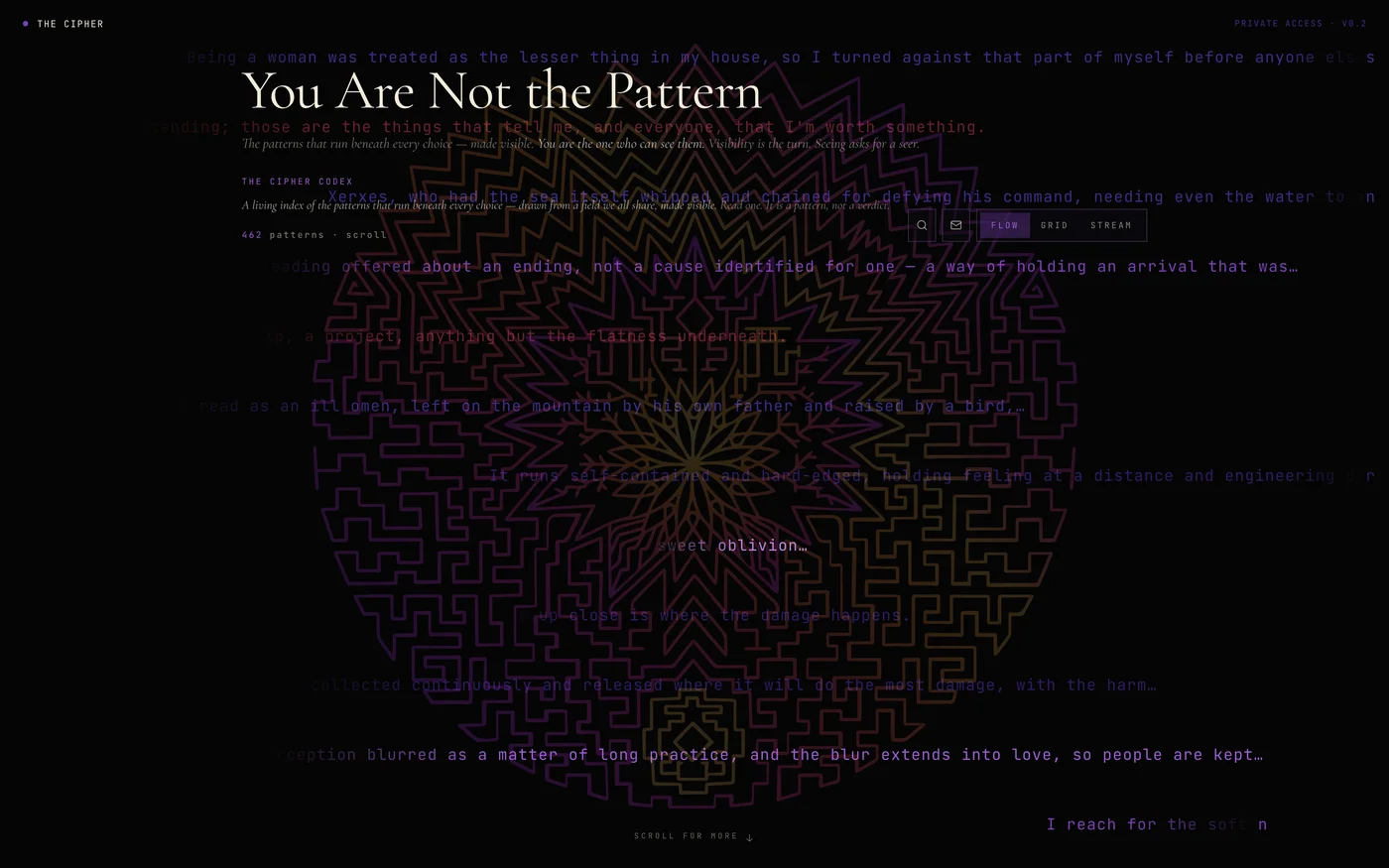
An ordinary library fills up one book at a time, each written by someone. The Codex on thecipher.is has no author — or, more precisely, it has all of them. It’s a living registry of human patterns: forms that run beneath people’s decisions, stripped of the person and the moment, kept as what they are. Faceless, collective, growing.
The idea sounds simple until you start building it. How do you make a library in which no one can recognize themselves, yet anyone can find their pattern? How do you count "how many times something was decoded" without counting people? And how do you launch 462 entries at once when the system calmly hands you 461?
This article is the behind-the-scenes story of a contemplative product — and of the day the launch nearly fell over a single missing entry.
What a living Codex actually is
A Codex pattern is self-contained: it carries only what’s intrinsic — a hook (its own voice, a single line), a decipher (the behavior, the cause underneath it, what it’s really asking for) and an archetypal form (who you are while it runs unseen, who you are when you see it). No field, no mode, no value — those belong to a reading, not to the pattern. The pattern belongs to everyone.
That’s the first architectural decision, and the most important: you separate the person from the form. A reading is private, personal, different every time. The pattern that comes out of it is impersonal, stable, collective. The Codex keeps only the second part. In database terms: a reading lives in a person’s private space; only the abstract form travels to the library — no name, no intent, no values, no trace of the person it surfaced in.
The hardest problem isn’t technical. It’s ethical.
Before any entry goes public, it passes a test: could someone recognize themselves in this? If the answer is yes, it isn’t abstract enough — it stays back.
It sounds like philosophy, but it’s a very concrete engineering constraint. Every word that reaches the Codex has been scrubbed of identifiers: not just the name, but any detail through which a reader could say "that’s me, that’s my case". The result is text that sounds universal — archetypal — and that’s exactly why it works as a mirror. A pattern that could belong to anyone is a pattern you can see yourself in without exposing yourself.
It’s also why the Codex is faceless by design: no visible category, no author, no popularity score. The patterns stand alone, equal.
The counter that’s a mirror, not a score
Every entry has a number: "Decoded N times". It isn’t a score. It’s a mirror.
The philosophy behind it is explicit: the number doesn’t say "you are this pattern all the more". It says "you’re not alone in it". A pattern you thought was only yours turns out to be a form that has run in many lives, decoded by people you’ll never meet. The counter counts decodings, not people; below a small threshold it hides itself (so "Decoded 0 times" never shows, which would read like an empty library).
Here was a move few would make: instead of starting every counter at zero and waiting for it to climb, we seeded them from real history. The assessment database held thousands of real runs — how many times each pattern had surfaced, over time. We counted the occurrences per pattern, tied them to the Codex entries through a stable identifier, and the library launched with real numbers, not invented ones: of 462 patterns, 206 already had history (some decoded 8 times), the rest at zero, ready to grow from the readings ahead.
A point of principle that matters: the numbers weren’t written by an "intelligence" querying the database. They were computed by code, directly, from real history — not hallucinated. In a product about truth, a counter that lies would have been fatal.
Launch day: 461 instead of 462
Here’s where the suspense starts.
The launch corpus was clear: 462 patterns, across three categories (153 + 155 + 154). Each with a stable identifier from the source database, ready to upload. The import ran, the check returned… 461. One was missing.
The kind of bug that stops you cold: everything looks correct, the count starts at 1, nothing screams "error" — just one pattern vanished from 462. The culprit, after digging, was a pair of siblings (two variants of the same pattern, distinguished by a Roman numeral) that shared the exact same textual identifier. The form’s deduplication saw them as a duplicate and silently dropped the second. A single exception out of 462 — but exactly the one that turns "ready to ship" into "hold on".
The fix wasn’t to patch the data, but the rule: an entry’s identity isn’t the id alone, it’s the pair (id, roman). Deduplication and slug were then done on that pair — deterministically, without touching the other 460 that were already correct.
Clean means clean
The day’s second lesson: when the database got dirty from iterations (repeated imports leaving clone-versions, changed slugs leaving orphans), the reflex to "fix it in place" only pulls you deeper. We chose tabula rasa: full wipe, fixed code, a single clean import on stable code. Result: 462 patterns, one version each, zero clones, zero orphans.
Worth saying, because it’s counterintuitive: for a batch of critical content, a clean re-import from scratch is safer than ten incremental fixes that look "cheaper". Every fix on a confused state adds an even more confused state.
How a pattern goes from private to public (without duplicating)
Under the hood there are two systems: one that owns the truth (where patterns are authored and edited) and the public library (the Codex) that mirrors it. The link between them is a stable identifier — not the name, not the title (which can change), but the CORE id of the source row. The join is made on it, the decodings are counted on it, any change propagates on it.
The principle is simple and we held it firmly: the source of truth lives in one place; everything else mirrors. A pattern authored once, correctly, arrives correct everywhere — title verbatim, the algorithm layer, the counter — automatically, on every publish. No manual join from files, no one-off scripts that everyone forgets next time.
And, in the loveliest moment of the day: after re-import, publish and sync, we opened a pattern’s page on the live domain and there, under "It appears in many lives.", it read "Decoded 8 times". Not locally. On the site. Real. 🥂
How the library grows from here
The set of 462 was the launch inventory — published manually, once. From here, the library grows organically: as the author adds new patterns to the pre-authored store, each becomes public the first time a real reading surfaces it. Pre-authored doesn’t mean pre-published. The library writes itself, out of readings, anonymous and aggregate — exactly what the name says: a living registry.
Conclusion
A living Codex isn’t a list. It’s an architecture of principles: separate the person from the form, test anonymity before anything else, count decodings not people, keep the truth in one place, and let the library grow from readings. The hard part was never the code itself — it was making sure that, in a library built from real experiences, no one can recognize themselves, and yet anyone can find their pattern.
461 instead of 462 was just one hard day. A pattern that appears in many lives — that’s the product.
See the project too: The Cipher — and the complementary, technical side: the payload optimization on thecipher.is.
Frequently asked questions
What is the Codex on thecipher.is? A public, living library of human patterns — recurring forms that run beneath decisions and behavior, stripped of the person and the moment. It’s faceless, collective and growing: each entry carries only what’s intrinsic (hook, decipher, archetypal form), never personal data.
What does "Decoded N times" mean? How many times that pattern was decoded in real readings. It isn’t a popularity score — it’s a mirror: a pattern you thought was only yours appeared in many lives. The counter counts decodings, not people, it’s aggregate and anonymous, and below a small threshold it hides.
How is privacy protected in the Codex? The reading stays in the person’s private space. Only the abstract form goes public — no name, intent, values or trace of the person. Before publishing, each entry passes an anonymization test: if anyone could recognize themselves, it isn’t abstract enough and it stays back.
How does the library grow? A launch inventory is published once; beyond it, each authored pattern becomes public the first time a real reading surfaces it. Pre-authored ≠ pre-published — the library writes itself from readings.
What is it built on? A modern web stack (Next.js), with two systems synchronized on a stable identifier: one that owns the truth (authoring/editing) and the public library that mirrors it. The decoding counter is computed from real data by code, not generated.
Do you have a product with a hard idea to carry all the way through? Get a quote — we get the principles right first, then the architecture. See our services too.